For as long as I can think I’ve had one or more songs every year that were like my own personal summer soundtrack. When I hear one these songs they put me right back in time by bringing back memories, smells, tastes, feelings, …

So here is this year’s song:

Video: Fiva - Alles leuchtet feat. 5/8erl in Ehr'n

What is interesting to note is that it makes use of different German accents.

Read more →

Cotton

· Music


I just felt like posting another youtube video of a song I’ve been digging lately. Enjoy!

Cotton
Read more →

Public-Key Cryptography is a truly magical thing and I often wonder why we don’t use it more often. We go on and complain about how it is too easy for government agencies to look into our digital lives, while we do have all the tools to prevent it. Only we don’t use them and we don’t seem to ask facebook, gmail and so on to use them - not that they would. The funny part is that it would not require a lot of effort, because computers could automatically do all of that stuff in the background. All that would be needed is that we were able to securely store one, long password (the private key).

In a nutshell public-key cryptography is a mathematical concept that allows us to encrypt a message that is intended to be read by just one person and to sign something to guarantee that it really came from you.

Let’s take a closer look: public-key cryptography is based on a pair of keys, lets call them #1 and #2. When one uses key #1 to encrypt a message one can only decrypt it again using key #2. The same is true for a message encrypted with key #2 - it can only be decrypted using key #1. In other words the two keys are kind of reversible operations that work in both directions. For instance

  • Plain text -> Apply Key #1 -> Cypher Text -> Apply Key #2 -> Original Plain Text
  • Plain text -> Apply Key #2 -> Cypher Text -> Apply Key #1 -> Original Plain Text

but

  • Plain text -> Apply Key #2 -> Cypher Text -> Apply Key #2 -> Nonsense
  • Plain text -> Apply Key #2 -> Cypher Text -> Try something -> Nonsense

In addition to that it is important to know that it is (almost) impossible to find the keys from the Plain text and/or the Cypher Text. Usually a person or entity (lets call this entity Alice) creates a pair of keys, where one is made public (the public key) and where the other key is kept secret. There are two typical use cases:

  1. Anyone can encrypt a message using the public key and send it to Alice. Only Alice and nobody else (e.g., someone who intercepts the cypher text) will be able to read the plain text when only Alice knows her secret key. - This use case is also called “Public-key encryption”.
  2. Alice can encrypt a message using her private key and send it to anyone. If it can be decrypted using the Alice’s public key, one has a guarantee that the original message really came from Alice. - This use case is also called “Digital signing”.

The secret key is Alice’s crown jewel that she must not lose or share with anyone, because anyone in possession of the secret key can do what Alice can do. Well that is why it’s called the secret key. Again, all of this can stay in the background and as it can be done for you by software on your computer/phone/…, that has access to your locally stored secret key. If you are interested in implementing some of this stuff in your life, you might want to take a look at

Just by reading this article and by understanding it, you should have a pretty good idea about what level of protection encryption can give you and where potential problems may lie. Again, never forget: your secret key is your crown jewel that you must never share and that your software must never leak. By the way, this is something that is especially hard to check with closed source software and also something that the heartbleed bug may have caused.

Read more →

“I am from Europe” is a phrase that I’ve found myself using quite frequently lately. I don’t just use it because Europe is much easier to explain than ___________ (fill in any European country you can think of), but because Europe is more than that.

I mean of course the statement is true from a geographical perspective, but then again it is more than that. Europe for me is the notion that there is this geographically large region that is so diverse in terms of culture and lifestyle but that still shares a set of unwritten core values, that every one of us can relate to and rely on.

I am aware of the stereotypes that all of use have. Germans are overly correct, the British can’t cook, Polish people are ueber-Catholic, Greeks are lazy and Spanish men are macho men on siesta. However if you dig deeper, if you are willing to immerse yourself in one or more of the “other” European cultures, you will find that there are more things that we have in common than those that separate us. - I mean except for the French, who I never really liked or understood. But then again, they enrich our union as much as you and I do.

Sometimes I am wondering what Europe must look like from the outside. Probably like someone suffering from Schizophrenia. Someone with so many voices inside and no clear, single voice to the outside. But that is alright, because when it comes to the important issues, everybody can and should rely on our common understanding. We do believe in human rights, in social welfare for those who need it and in an economic system that encourages everybody to thrive based on his or her personal talents but one that should leave nobody behind.

From the inside it is probably a little bit like marriage. - There are good times and bad times, and things are far from perfect. Every now and then we are put on trial, and at the same time we often don’t appreciate what we have because of the union. But even if one party has to give in and do something that might hurt, we are better off as a union.

At the end of the day it comes down to this: I am in awe of what Europe is and more than that of what it can become: A super-powered peace-keeping instrument and a diverse, flourishing system with shared values and the inherent ability to see challenges from multiple perspectives. It’s now on us to act and voice our vision for Europe, so don’t miss the elections http://www.elections2014.eu/

Read more →

A while ago I stumbled across a TED talk in which Matt Cutts presents the idea of trying something new for 30 days.

TED talk

If you are as bad at sticking to resolutions as I am, I highly recommend giving it a try. 30 days really seems “just about the right amount of time”.

Here are some of the 30 days projects that I have done and blogged about so far:

Read more →

Today’s my birthday.

Your birthday is kind of like your personal new years eve. A moment when you review the bigger picture, reflect on the past and the future and make resolutions.

I am not good at resolutions but the 30 days thing has worked for me. So here’s my new challenge: Knowing that I do often eat/drink way too unhealthy stuff I’ll take a picture of (almost) everything that goes into my mouth for the next 30 days. No I’ll not include water too often, and I’ll feel free to skip anything that has 50 kcal or less.

If everything works out you should see things pop up on my newly created pinterest board soon. Happy eating!

Happy Eating

Read more →

TED talk

This time the next 30 days will be about subtracting rather than adding.

My life has become pretty cluttered again. Too much stuff around. Too many things - including skeletons - in my closet, too many things on my table, too many random folders on my computer, too many empty boxes in the basement … way too little focus on the important things.

Every day for the next 30 days I’ll clean up some of that mess - sometimes with before after photos, sometimes not.

Read more →

The goal was to come up with a blog post every day for 30 days. Well, I didn’t blog every day, but in the end I wrote 30 posts, which concludes my experiment. There were days without blog posts because either I didn’t have anything to say, or because I decided not to publish certain things. What can I say: I will not continue to blog that regularly. Not only because it takes a lot of time, but also because it feels way too self-centered. Still it was a good exercise. Here’s a list of all 30 blog posts:

Good thing: now I’ll have to find another 30 days project ;)

Read more →

I’ve started writing about it so I should finish it.

Where we left off: I had a job interview last week and I was expecting an offer in the next couple of weeks. Guess what: I received an offer today. And it did not come via a professional employer organization. No: Infineon made a valid, legit offer that truly is worth a thought.

In terms of money the offer is neither particularly good nor exceptionally bad.

Knowing what kind of salary to expect is one of the hardest things. Nobody in Austria really talks about their salary so you mostly rely on what friends tell you, internet research and what public research institutions pay (which has to be made public, because of transparency). Here are some examples of how I evaluated Infineon’s offer.

I have friends (also PhDs) working at Siemens VAI who earn about 5% more without the all-in option that Infineon has in all its contracts. The all-in option in Austrian contracts means that overtime will not be paid, as the salary is said to cover any overtime already. You would have to fight really hard to get rid of that option and accept a reduction in salary of about 15%. As 5% is not that much, it really comes down to the question of how much overtime you are expected to do. -> Neither good nor bad.

The post-doc position that my friend Reinhard has at university comes with exactly the same salary (according to the collective contract of the Austrian university system). My adviser also offered me a position as post doc, but I don’t think that the university landscape is for me. At any rate: -> Neither good nor bad.

Some information about what PhD graduates earned in Germany in 2012 can be found at http://www.ingenieurkarriere.de/_library/content/download/obj2407_Einstiegsgehaelter_fuer_Ingenieure_2012.pdf - Being just a little below what was the 50% mean tells me: -> Neither good nor bad.

It comes down to this: I will not sign that contract right away (as I would have if the offer were really outstanding) but I am also not going to turn it down. Starting in mid-March I will start looking for other options and when I have a range of offers, I will sit down to do my pros and cons list. The fact that I could put to use my knowledge in the probably most efficient way will be on the pros side and the salary will not be everything as long as it is above my personal limit of … well I am not going to share that number.

Actually I will not share any other information about my job search on this blog from now on. With HR being good at googleing these days, I guess it is safer that way. I am still glad I blogged about this first job application as it helped me bring order to my thoughts, realize what is important to me and define what my limits are.

Read more →

Arts and Jazz

· Music


Another night out playing some jazz music. This time for the visitors of the vernissage of Austrian artist Jörg Wascher.
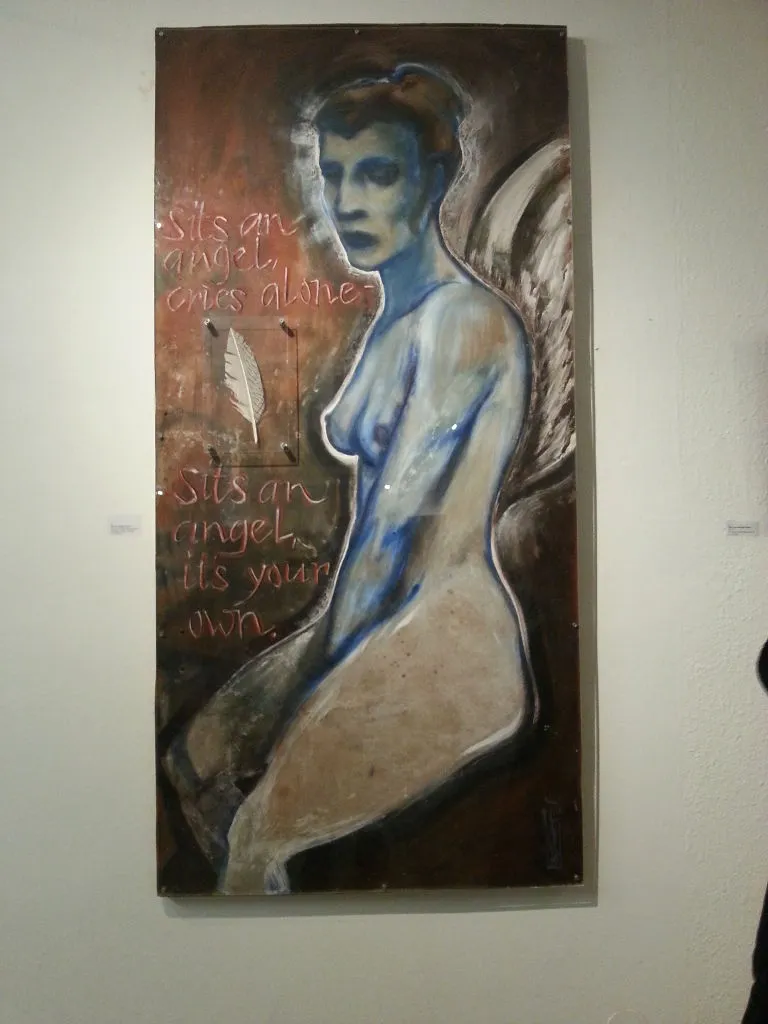
wascher

The gig was ok although for me listening to Jazz while looking at art (mostly paintings, but also some sculptures) and drinking wine is a little bit too much of a cliché. Plus I don’t like background music in grocery stores, so why would anyone like it at a vernissage?

But it’s not my call, we got paid for the gig and I really enjoyed playing with that group. We were four and we have not played in that setup before, but interestingly all share some kind of common history or are linked otherwise.

The trumpet player, Erwin, and I are friends for a long time. He also studied mechatronics, and obtained his PhD a couple of years ago. After being a post doc at KU Leuven he’s now back at JKU for another post doc position. His office is on the same floor as my office.

The bass player, David, was the youngest of our group, about age 20. He studies bass at Anton Bruckner university, the school where I studied jazz piano for some time. And here it comes: We also were neighbors for most parts of our lives! Our parents are still neighbors. David has an older brother Joe (we’re almost the same age), who is a brilliant guitar player. It really is interesting that neither my personal, nor Joe’s or David’s musical paths crossed while we still lived in Thalheim. - I played in a band with Joe later and with David for the very first time tonight, but not before anyone of us was older than 20.

The drummer, Markus, played in Joe’s band while we were teenagers, and I would see him every now and then from across the street. Also he was one of the best friends of a very good friend of mine, who I met much later - they went to the same music highschool. So I have met Markus again at a couple of birthday parties since then. - He went on to become a professional drummer.

It is funny to see how all of us are connected to other people in such diverse ways, how we develop our own paths. And sometime, like magic, they cross again, or lead into different directions …

Read more →