I do not usually do product reviews, but as I invested significant time and effort, I thought you might find this write-up useful.

My starting point: After resigning from first trombone in our local hobbyist brass band, I had to return the instrument they had loaned me over the past 25 years. A beautiful, gold-plated Willson trombone with a Rotax Valve. Not an easy goodbye.

While I mostly focus on playing the piano these days, I would rate myself as semi-professional on the piano, I still get to play the trombone once a month for small gigs (funerals, church, X-mas events, …). So I needed a trombone. I started with the following requirements:

  1. Use case: Everything, from orchestras to big bands to small groups.
  2. F valve section required
  3. Reasonably priced, i.e., below 3000 € because
    • my current level of playing does not justify one of those custom instruments
    • it will be used in all kinds of weird situations where dents might will occur, e.g., small stages where other amateur musicians will hit my instrument with theirs.
  4. Nice tone, good playability (slide, valve) and ergonomics
  5. Last but not least: Build quality that should get me through the next 30 years without foreseeable issues.

After consulting with two friends, who are professional trombone players, I narrowed down my selection to 4 instruments: 2 refurbished trombones, the Yamaha YSL-548 and the Rath R400. Especially the latter two to me seemed proper competitors. Both are in a similar price range: 2000-2500 €. Both tick off requirements 1-3 from my list above. Both claim to be “step-up instruments”, positioned between entry-level and full-custom / professional instruments.

From Yamaha’s Website on the YSL-548: “… eventually a beginning student model horn will start to hold them back. Yamaha offers the perfect line of instruments to keep pace with their burgeoning musical growth…Allegro.”

From Michael Rath’s Website on the R400: “For those looking to progress from a beginner’s instrument to their first professional level trombone the R00 series of instruments is excellent in developing style and technique before progressing to a fully customized trombone.”

I got both horns, the Yamaha from a local dealer and the Rath from the Thomann Online Music store. I liked the sound of both instruments. The ergonomics are good on both, with a slight advantage for the R400 because of its thumb rest. The YSL-548 wins the valve competition: smoother action.

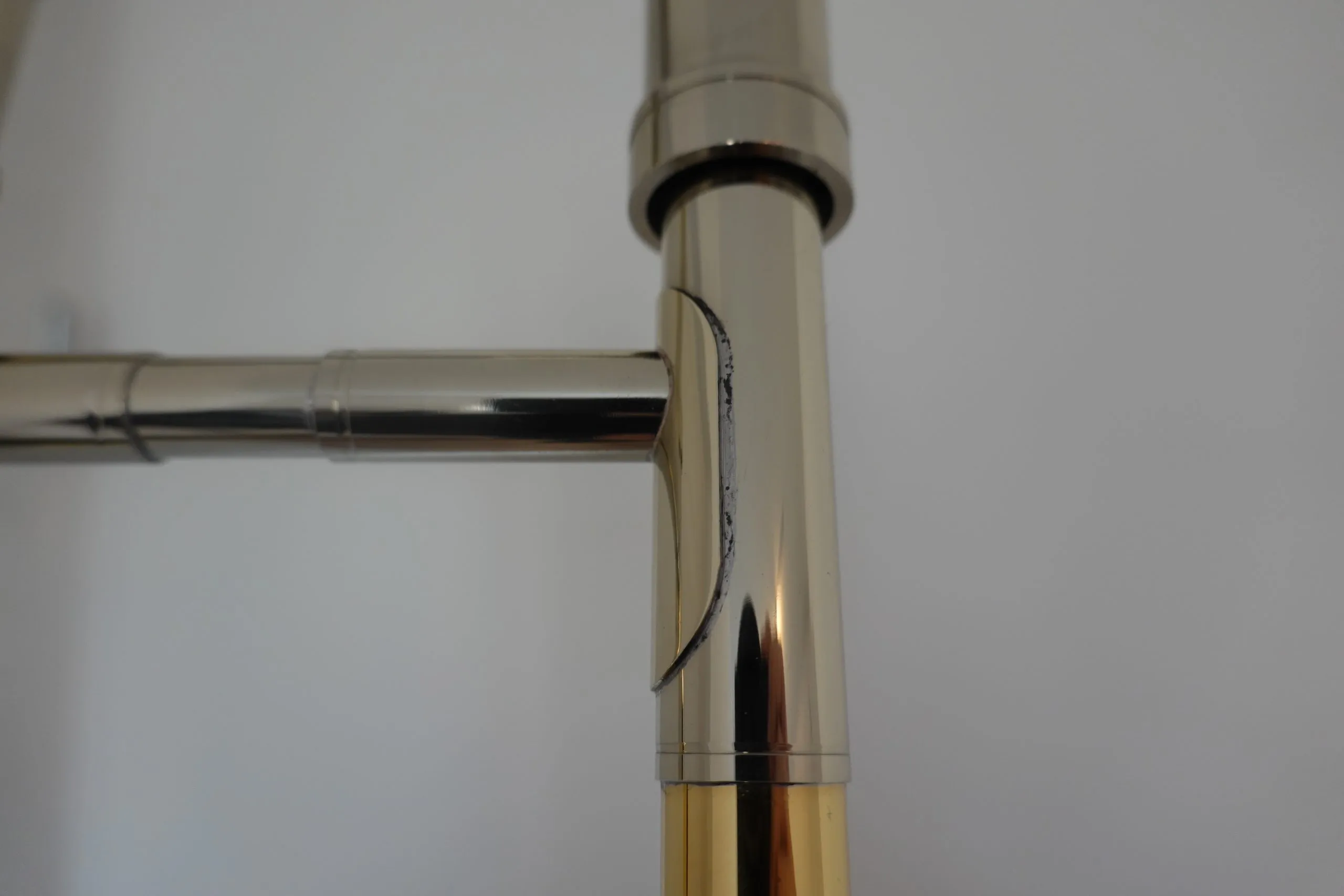
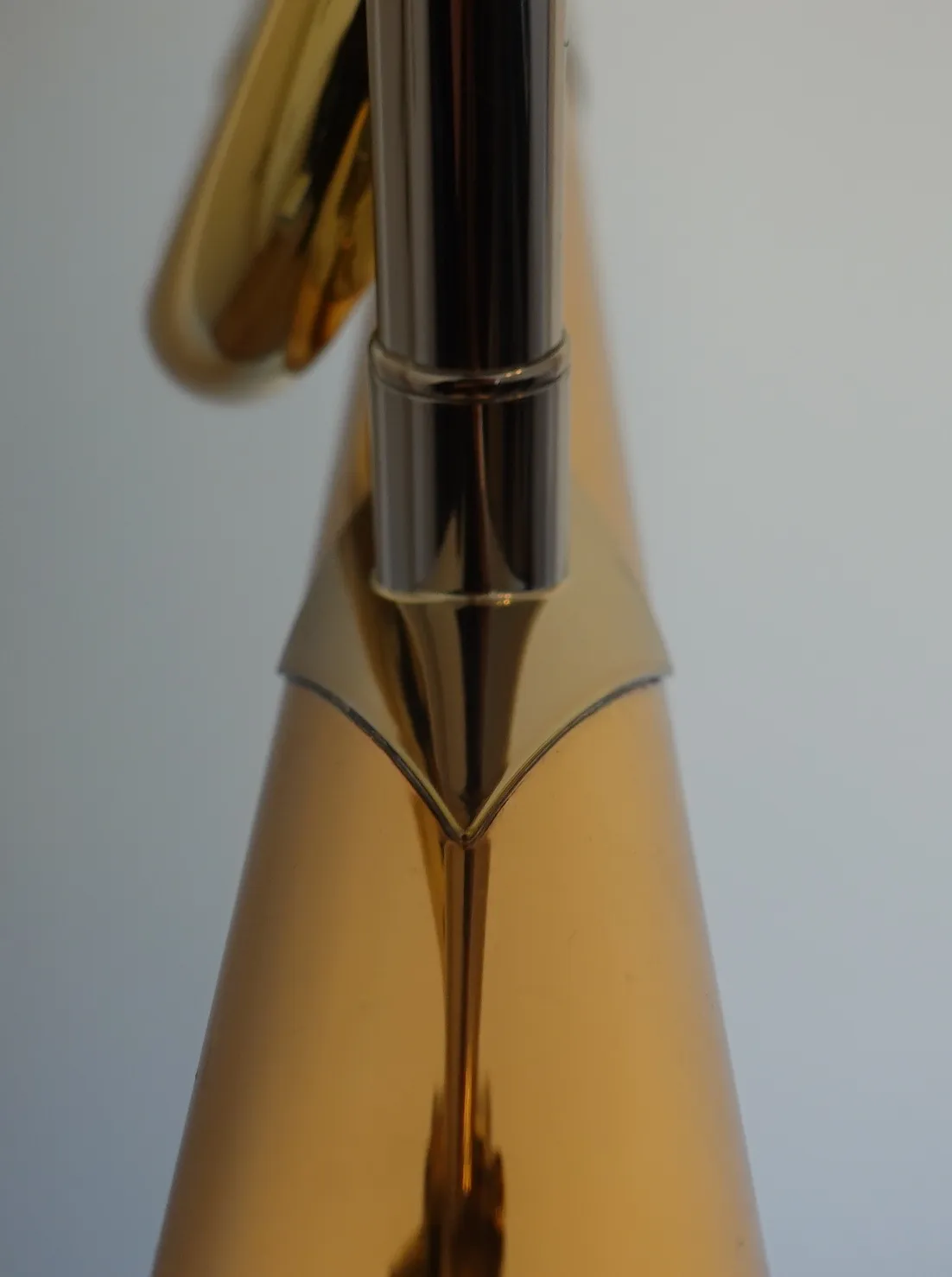
But here comes the big one: Boy was I blown away by the differences in build quality when comparing them side by side. In my opinion the Yamaha made the R400 look cheap, rather than a serious competitor. While I am aware that the R400 is actually manufactured in China, Rath also claims:

“Whatever your needs, the Rath R00 series of trombones offers a unique combination of the highest level of input of design and craftsmanship in trombones with the production qualities that make Michael Rath trombones famous around the world … So when expert training and quality materials are put together and quality control adhered to, it is irrelevant where the manufacturing location is … The Rath R00 series represents excellent quality, playability and affordability!”

Based on these statements and the photos from the online store my expectations in terms of build quality were high. What I got though, especially with the Yamaha right next to it, did not live up. Let me summarize the Rath build quality in one photo:
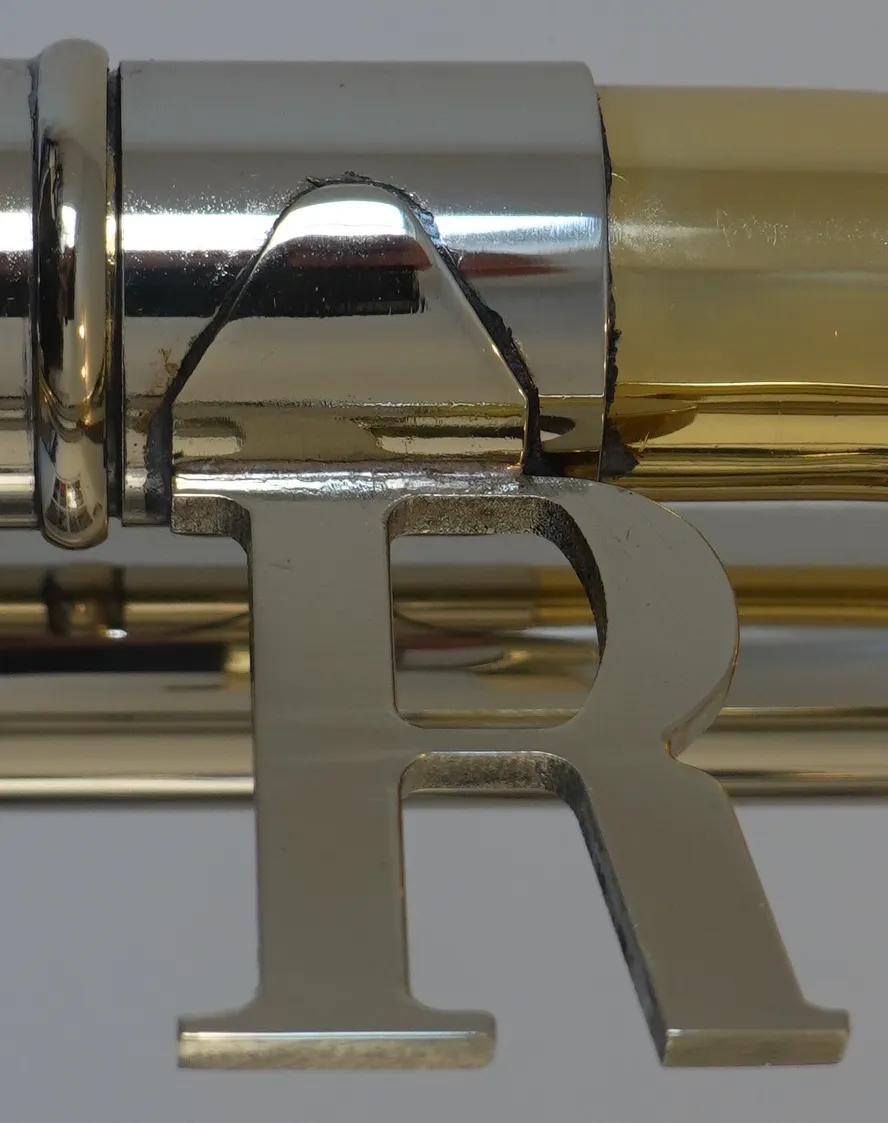
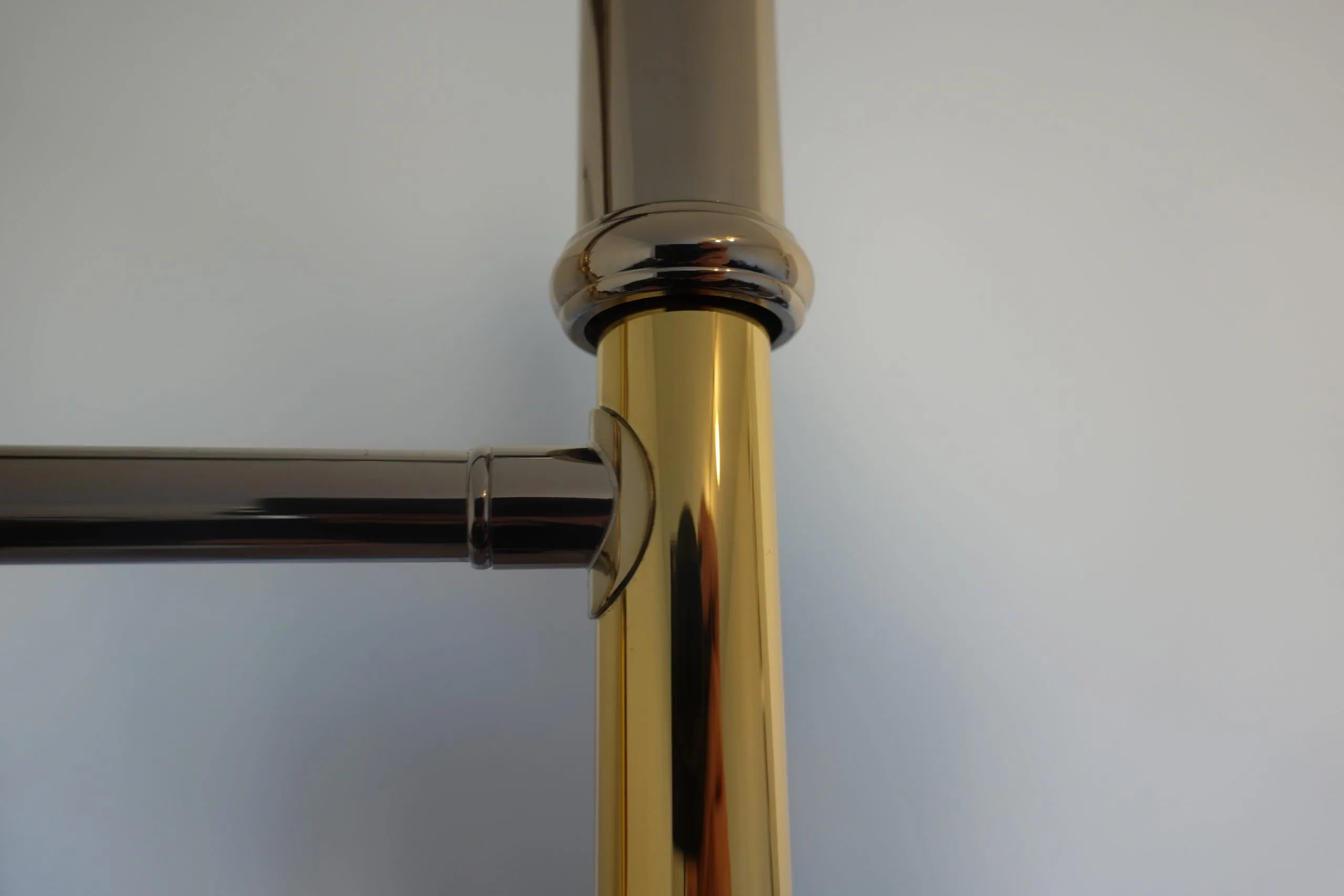
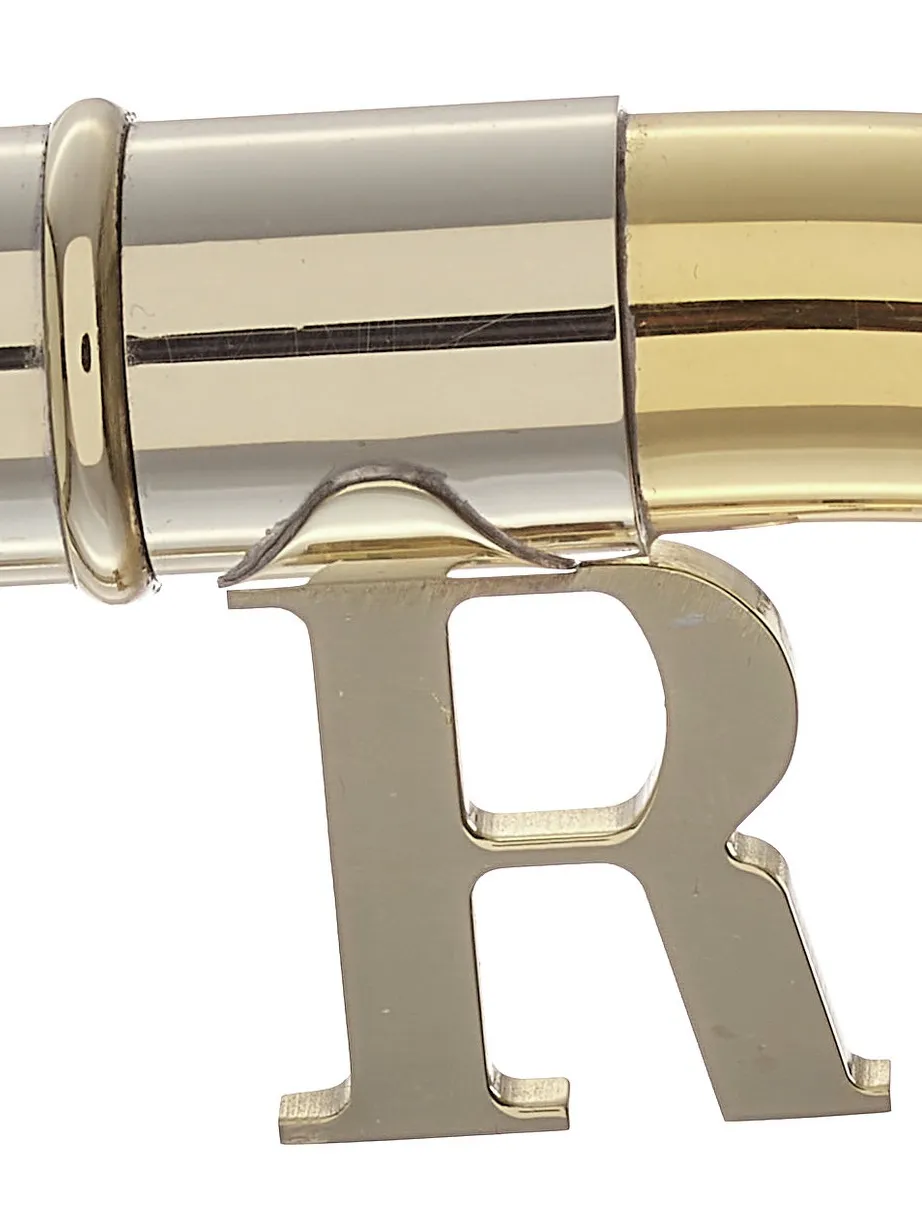
Yes, this is a mint Rath R400. By the way, this was my expectation based on the photos from the Thomann Online store:
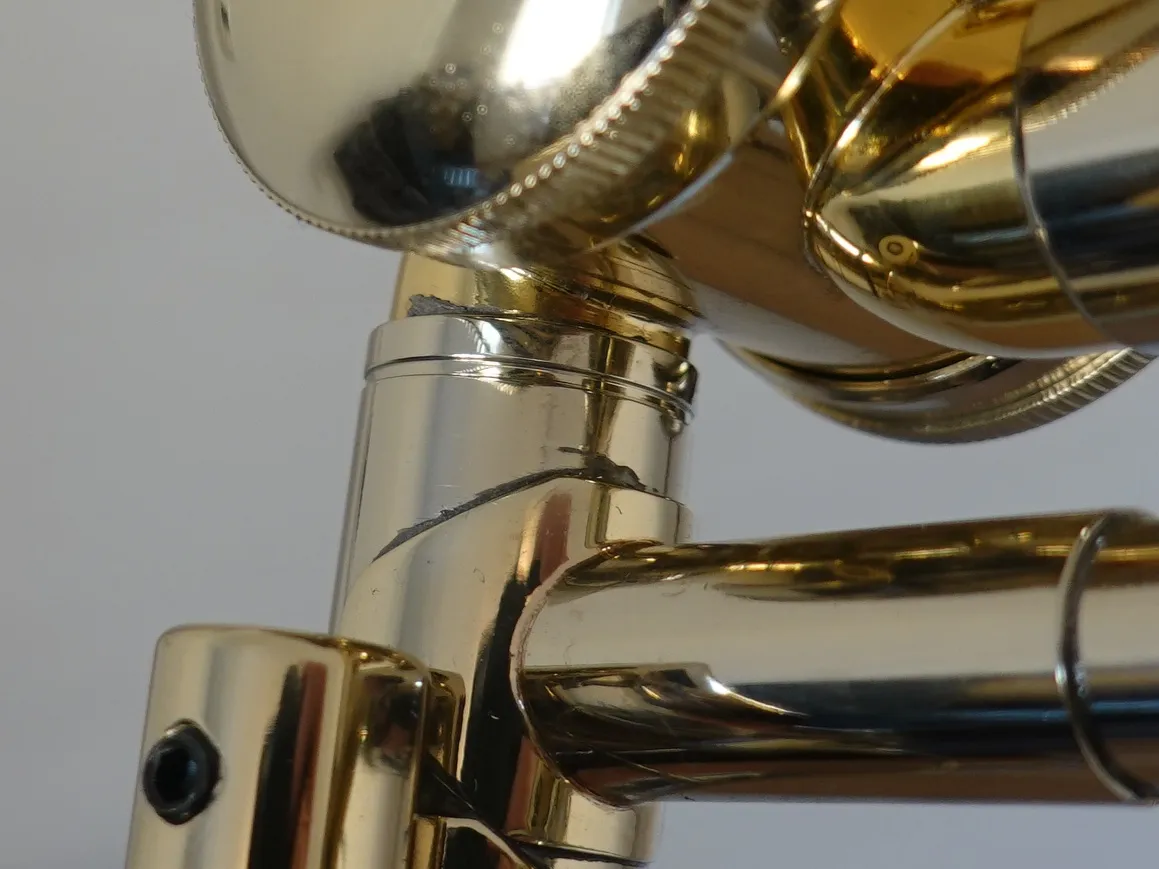
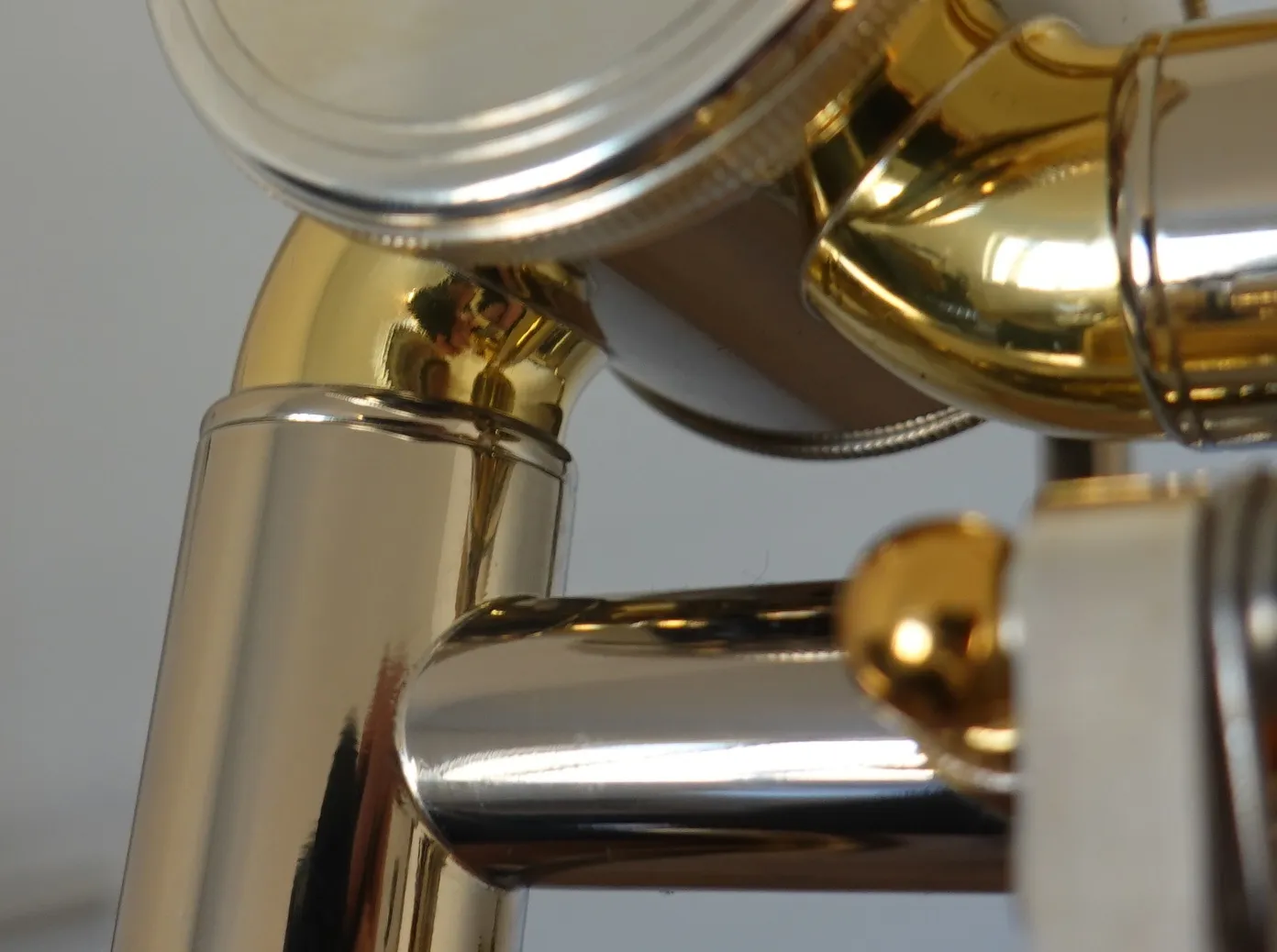
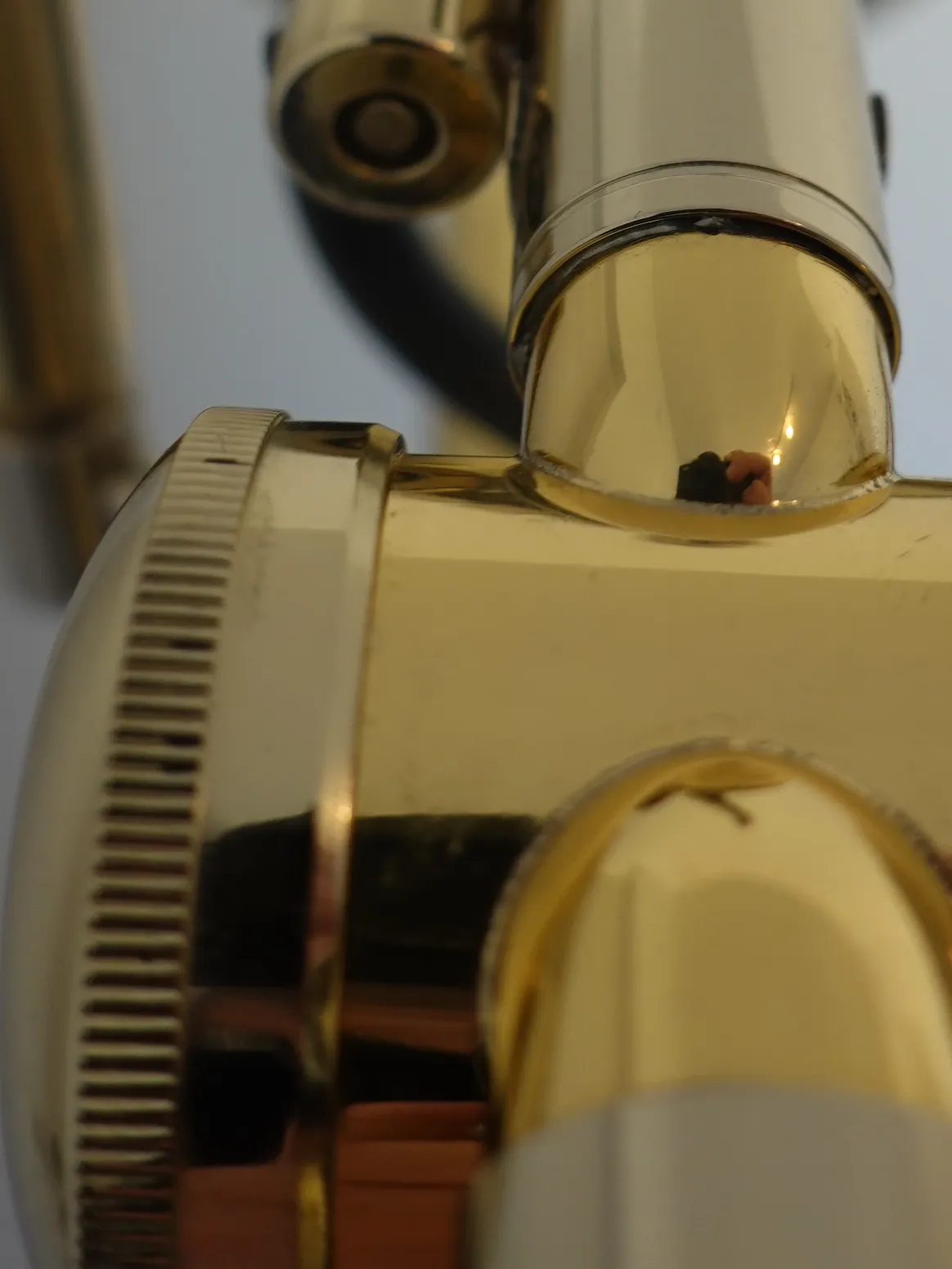
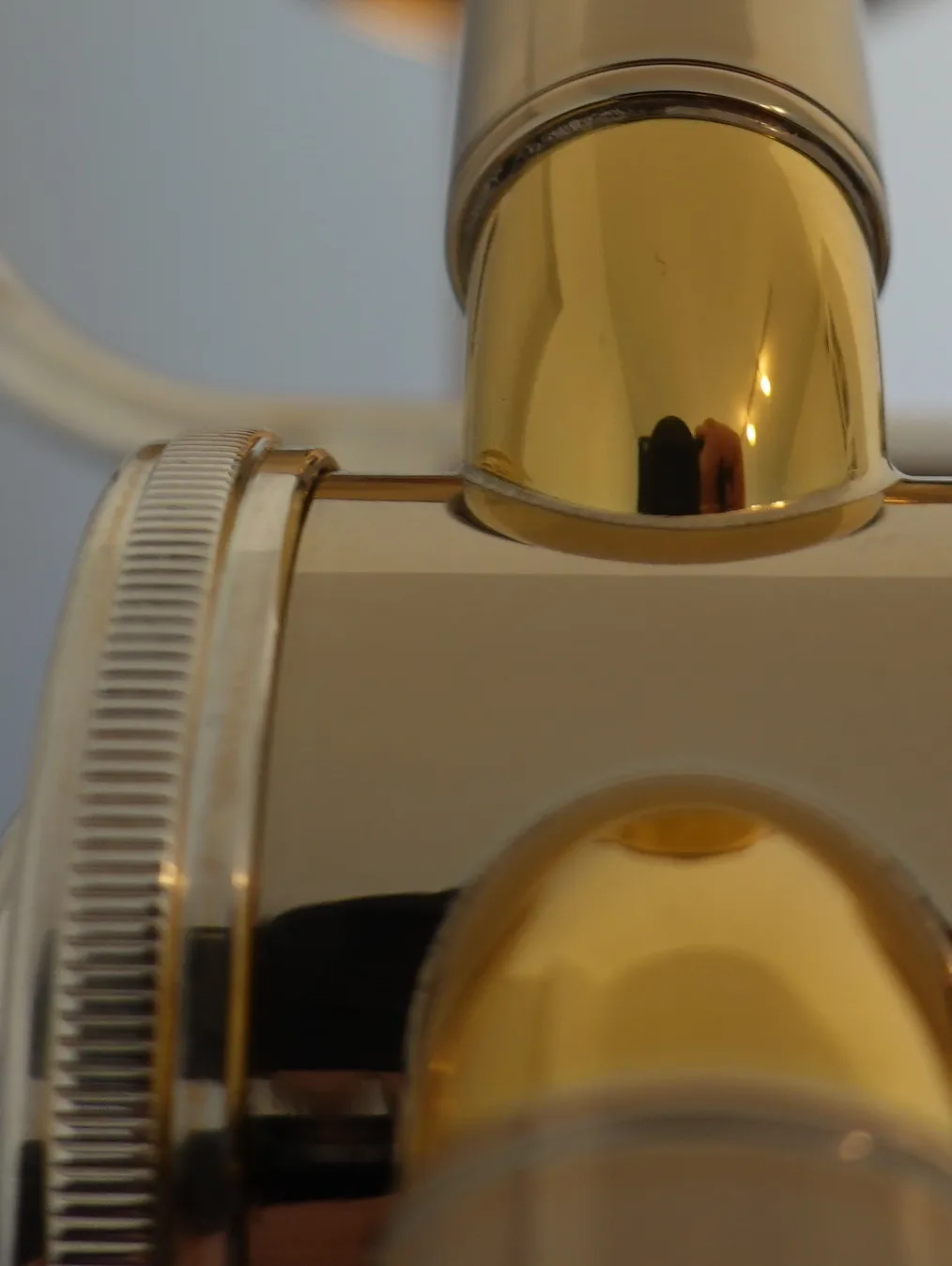
To let you in on the side-by-side experience with the Yamaha YSL-548 here some close-ups of similar parts from both instruments:
R400 YSL-548

R400 YSL-548

R400 YSL-548

The difference was striking. You may argue: Well it’s just cosmetics. But there some spots on the instrument where I am not even sure if there is sufficient solder material going all around the pipe connections. On the R400 there is a visible gap between the outer and inner pipe of some joints.
R400
YSL-548

By the way, those black dots on the kurled valve caps on the R400 really are under the lacquer. Which brings me to the next issue: the lacquer, there are at least two spots on the R400 that I had in my hands that looked like this.
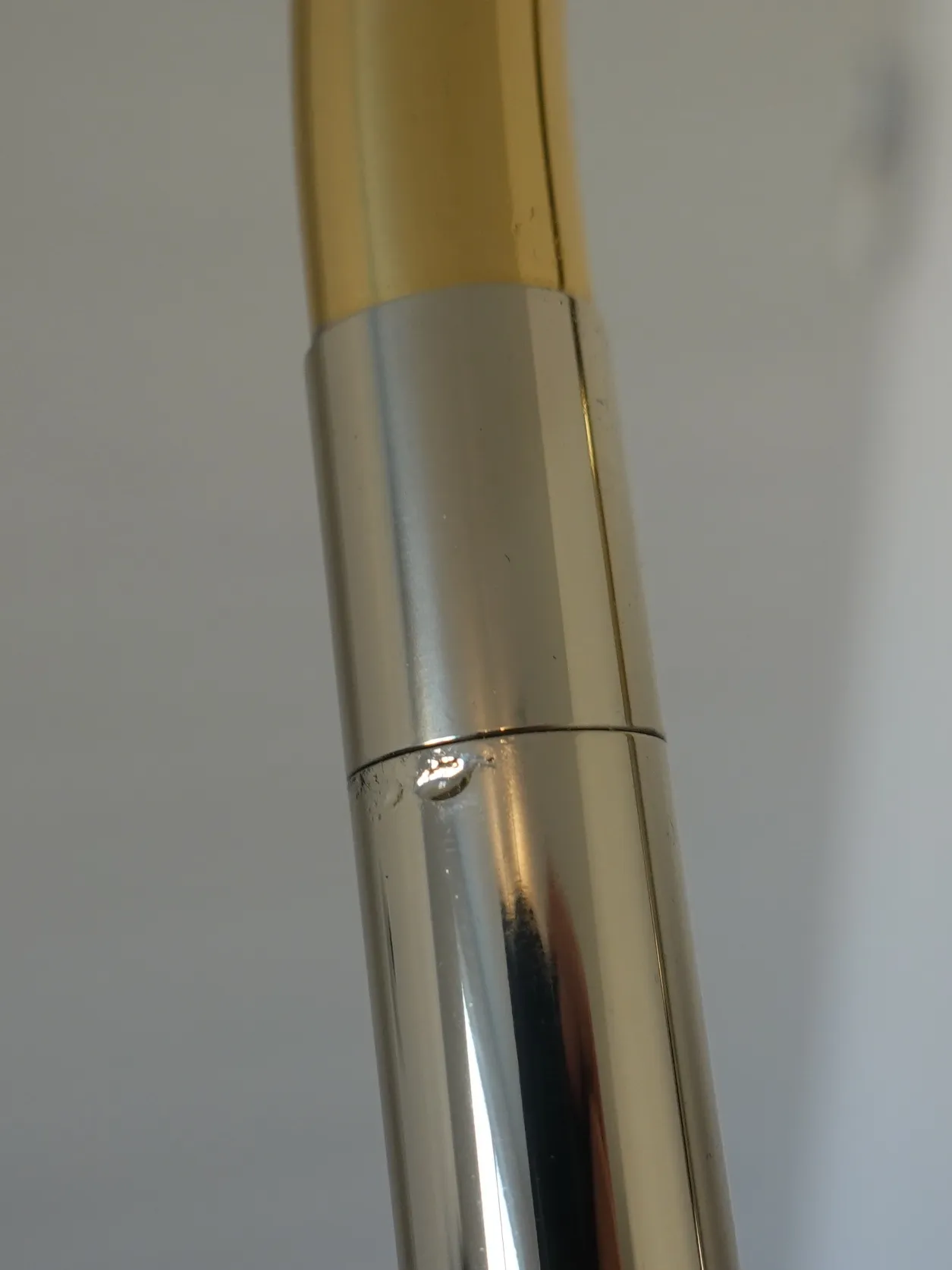
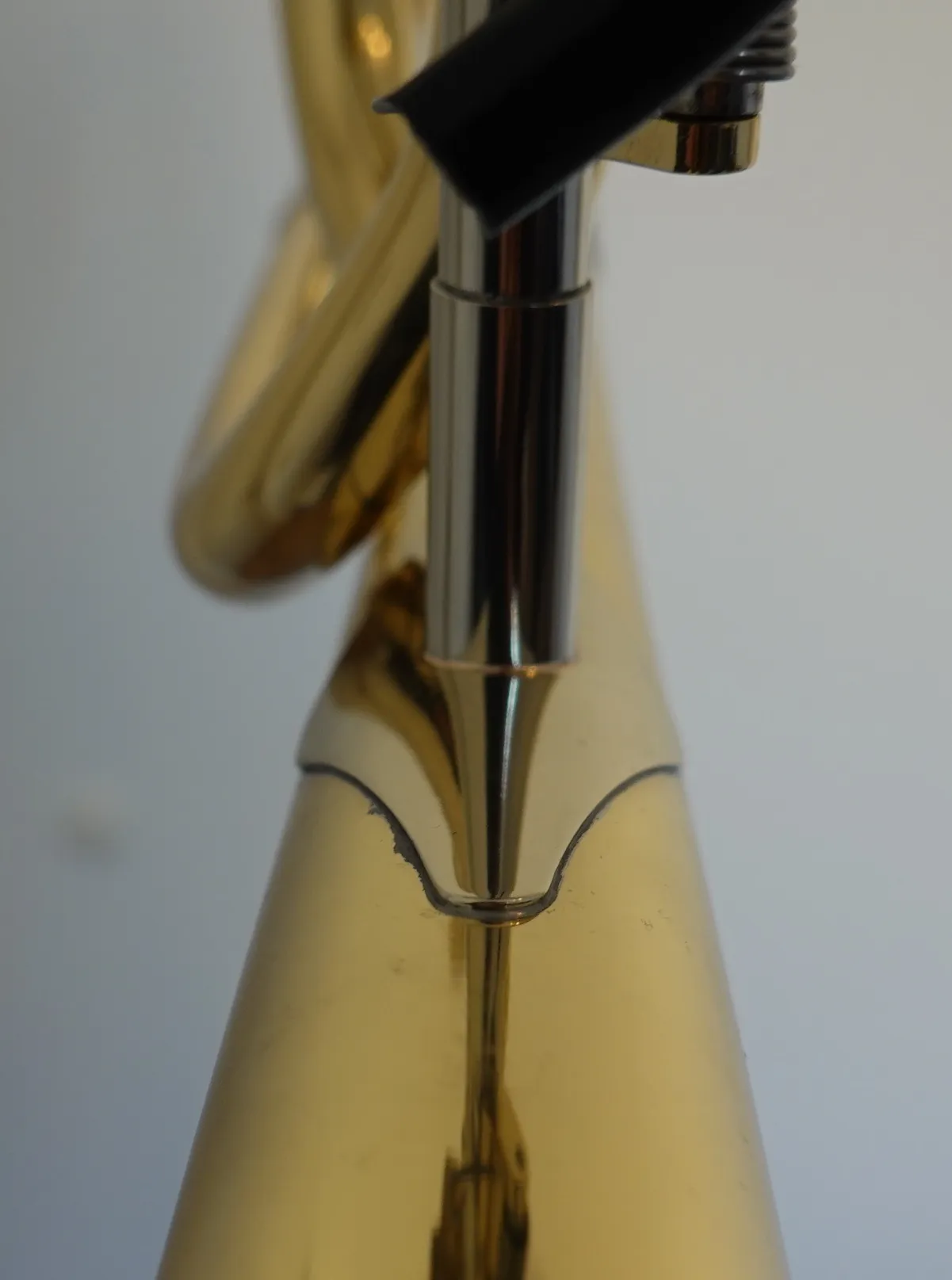
No its not water drops, its lacquer. Perfect execution on the Yamaha. Also the color of the bell is not even on the R400. This was too hard to capture on a photo as you will only see it clearly when you move the instrument and realize that it’s not shadows you are looking at but coloration that moves with the bell. It’s like the polishing was not done evenly or some oxidation happened before lacquering. The final point I’d like to make is with respect to the design. There is this one spot on the R400 that looks like this - by design:
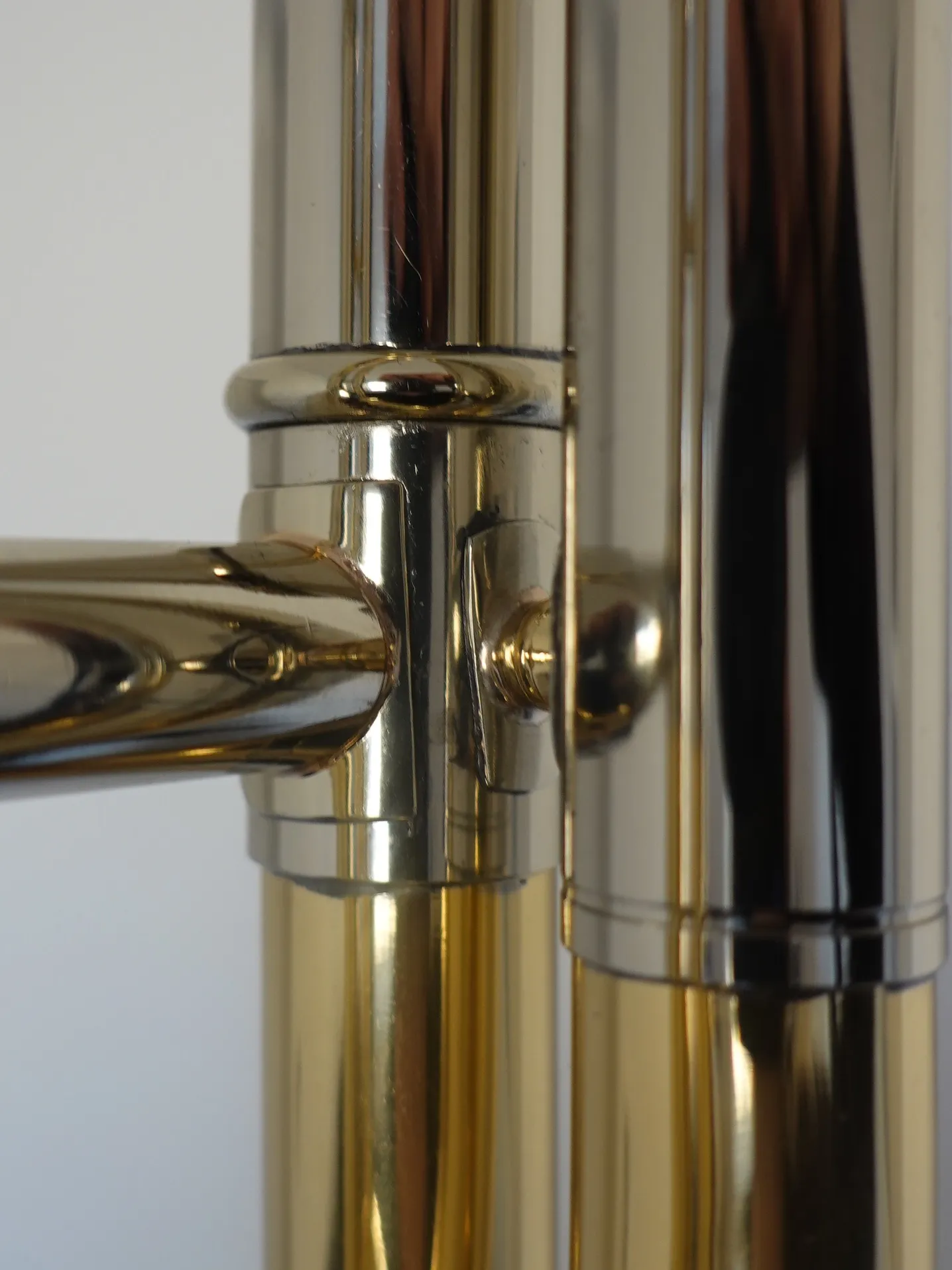
What we see here is two solder joint “landing pads” that both come in a certain shape - the right one is round, the left one has a more involved shape. Both landing areas are so close to each other, that both the rounded pad and the other one had to be cut off manually to allow for them to be soldered. To me this looks somewhat improvised/ugly and I would regard this as a design weakness.

Let me be clear: I am not a trained brass instrument technician. I have no idea as to why many of the solder connections on the R400 are black, huge and ugly and others seem to have come out nicely. I can also not judge on the long term effects these observations, e.g., the drops of lacquer, will have. The only point of reference I have from my professional life as an electronics engineer is PCB soldering. There black solder connections are a sign of poor quality which often leads to issues down the road. It happens when for example the temperature is too high and the flux burns too fast or when wrong materials are used. Experts usually don’t produce such results. In any case: As an uninitiated, yet critical customer comparing the R400 to a Yamaha at the same price point and other more expensive competitors, I can’t help but feel that there is something off about Rath’s statement:

“So when expert training and quality materials are put together and quality control adhered to, it is irrelevant where the manufacturing location is”

To me it seems more plausible that in terms of build quality the Rath R400 should belong in the same bracket as say certain Jupiter and Thomann instruments. - Which are priced at half or even less of what the Rath R400 costs.

Needless to say, I kept the Yamaha YSL-548 and sent back the R400. Kudos to Thomann. As always, they uphold there promise on customer satisfaction and I could send the instrument back free of charge.

For a brief moment, before I had the Rath R400 in my hands, I thought that I could get out of Yamaha land - I own four Yamaha stage pianos and synths and obviously keep coming back for they have never let me down. I thought: Let’s go for a small shop in England rather than the big cooperation. Sorry Yamaha that I was unfaithful. While there are ultra high-end and expensive instruments that outshine your products (think Steinway pianos, custom-built Rath trombones, …), when it comes to performance and cost, you consistently are a top-tier contender.

Dear reader: You are in the market for good quality at a reasonable price but don’t want the hassle of comparing all available options? Don’t worry, go for Yamaha.

Read more →

Git is a free, open-source distributed version control system designed to track changes in source code during software development.

git

Setup

git config --global user.name "Christian M. Schmid"
git config --global user.email "xxxx@xxx.xxx"
git config --global color.ui auto`

Initial Creation

git init
git remote add origin git@git.vs56.net:christian/NAME.git
...
git push --set-upstream origin main # First push of commits
git clone git@git.vs56.net:christian/NAME.git

Working Solo with One Branch

git add -A # Stage all files
git add FILENAME # Stage a file
git checkout FILENAME # Revert a file
git commit -m "MESSAGE" # Commit all staged changes
git push # push to main branch to origin
git push REMOTE BRANCH # push BRANCH to REMOTE
git pull

Branching

git branch # Show branches
git branch new-branch # Create branch
git branch -m OLD_NAME NEW_NAME # Rename branch
git checkout -b NAME # Create and switch branch

Handcarry old Git to Forgejo

If you have a clone of the repo on the computer already:

git remote set-url me "git@git.vs56.net:/mnt/Vault/oldgit/NAME.git"
git pull me
git remote remove me
git branch -m master main
git remote add origin git@git.vs56.net:christian/NAME.git
git push --set-upstream origin main

If you want to carry it over

git clone "git@me.vs56.net:/mnt/Vault/oldgit/2019_09_18_Oma_Briefe.git"
git remote remove origin
git branch -m master main
git remote add "origin" ssh://git@home.vs56.net/christian/Omas-Briefe.git
git push --set-upstream origin main

References

Read more →

PDFtk is an open-source command-line tool for manipulating PDF documents, allowing users to merge, split, rotate, and encrypt PDFs, among other functions.

Concatenate

pdftk in1.pdf in2.pdf in3.pdf cat output out_123.pdf
pdftk *.pdf cat output out.pdf
pdftk A=in1.pdf B=in2.pdf cat A B output out_12.pdf

Interleave

pdftk A=odd.pdf B=even.pdf shuffle A B output collated.pdf

Remove / Split

pdftk in.pdf cat 1-12 14-end output out.pdf
pdftk foo-bar.pdf cat 1-12 output foo.pdf
pdftk foo-bar.pdf cat 13-end output bar.pdf
pdftk foobar.pdf burst output foobar-%d.pdf

Split Even/Odd

pdftk collated.pdf cat 1-endeven output even.pdf
pdftk collated.pdf cat 1-endodd output odd.pdf

Rotate

pdftk in.pdf cat 1-endeast output out.pdf

Extract

pdftk in.pdf cat 20 output out.pdf

Edit Table of Contents

pdftk in.pdf dump_data > info.out
pdftk in.pdf update_info info.out output out.pdf

Edit info.out

...
NumberOfPages: 36
BookmarkBegin
BookmarkTitle: 01. Title
BookmarkLevel: 1
BookmarkPageNumber: 2
BookmarkBegin
BookmarkTitle: 02. Title
BookmarkLevel: 1
BookmarkPageNumber: 3
...

References

Read more →

Click here (FIXME: FILE TOO BIG) to download Christmas Reharmonized, Volume 1 & 2 (FIXME: FILE TOO BIG).

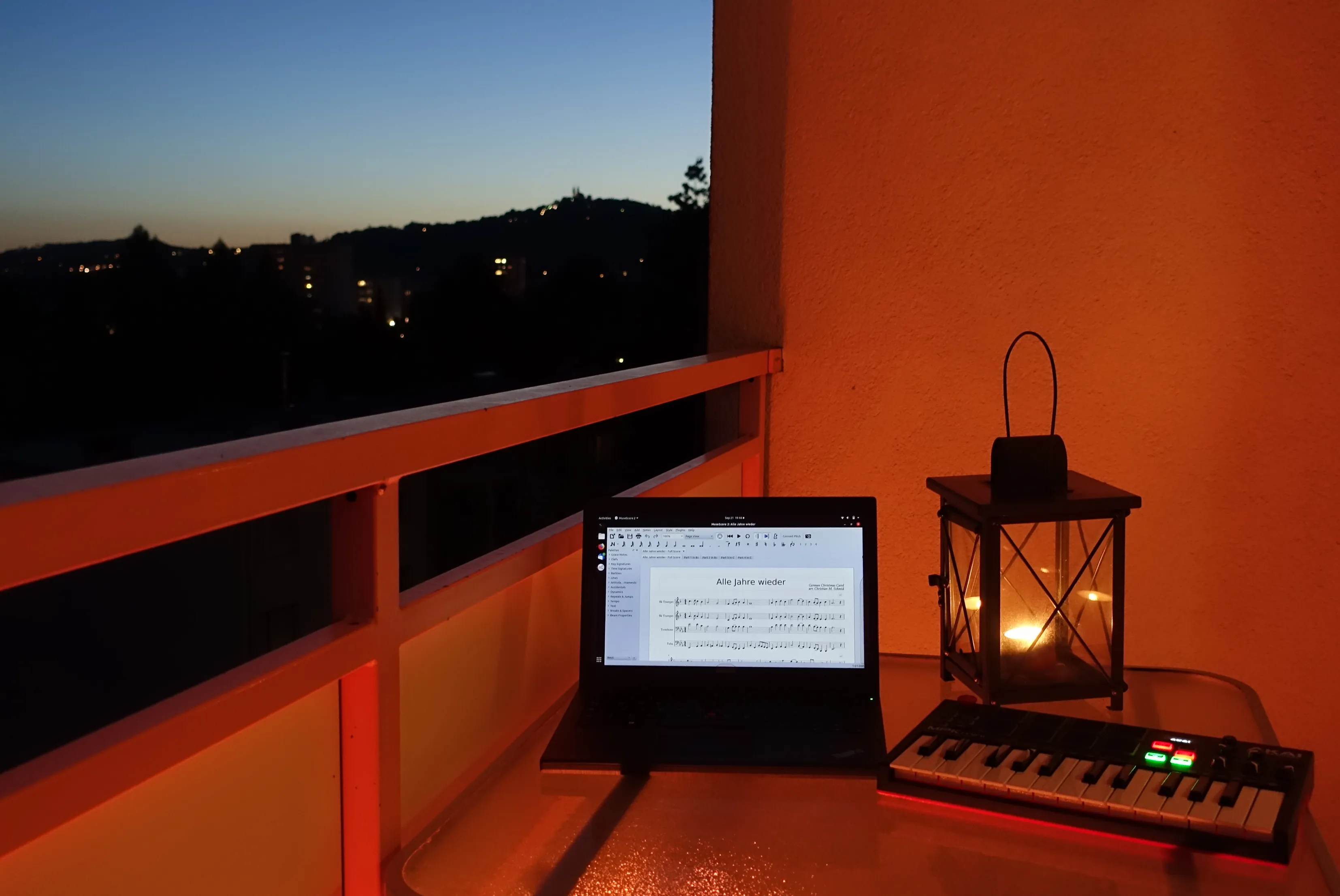
I started doing reharmonizations of Christmas tunes for brass quartet (2 trumpets, trombone or baritone, tuba or bass trombone) a couple of years ago. For your convenience I’ve compiled them all in one book: This is Christmas Reharmonized, Volume 1 & 2 (FIXME: FILE TOO BIG). It includes eight tunes:

1 - Andachtsjodler - an Austrian Christmas Carol

2 - Still, Still, Still - an Austrian Christmas Carol

3 - Alle Jahre Wieder - a German Christmas Carol

4 - Leise Rieselt der Schnee - a German Christmas Carol

5 - O Tannenbaum - a German Christmas Carol

6 - Es Wird Scho Glei Dumpa - an Austrian Christmas Carol

7 - Adeste Fideles - O Come, All Ye Faithful

8 - Carol of the Bells - a Ukrainian Folk Song

All of the arrangements consist of parts using traditional arranging techniques and of reharmonized parts.

The download (FIXME: FILE TOO BIG) includes printable sheet music (pdf), audio files (mp3) of the tunes played on piano and the original musescore files. All of this under a considerate Creative Commons Attribution 4.0 International License!

Merry Christmas!

Read more →

O Tannenbaum

· Music


Download brass quartet sheet music: O Tannenbaum.

Please note that “O Tannenbaum” is also part of the compilation Christmas Reharmonized, Volume 1 & 2.

Here’s what it sounds like when played on a piano:

The Story Behind

I love Christmas Carlos and I love performing them with brass quartets in December. With Corona lurking around every corner, 2020 was quite different and hard both for professional and amateur musicians. Many turned to delivering their content online.

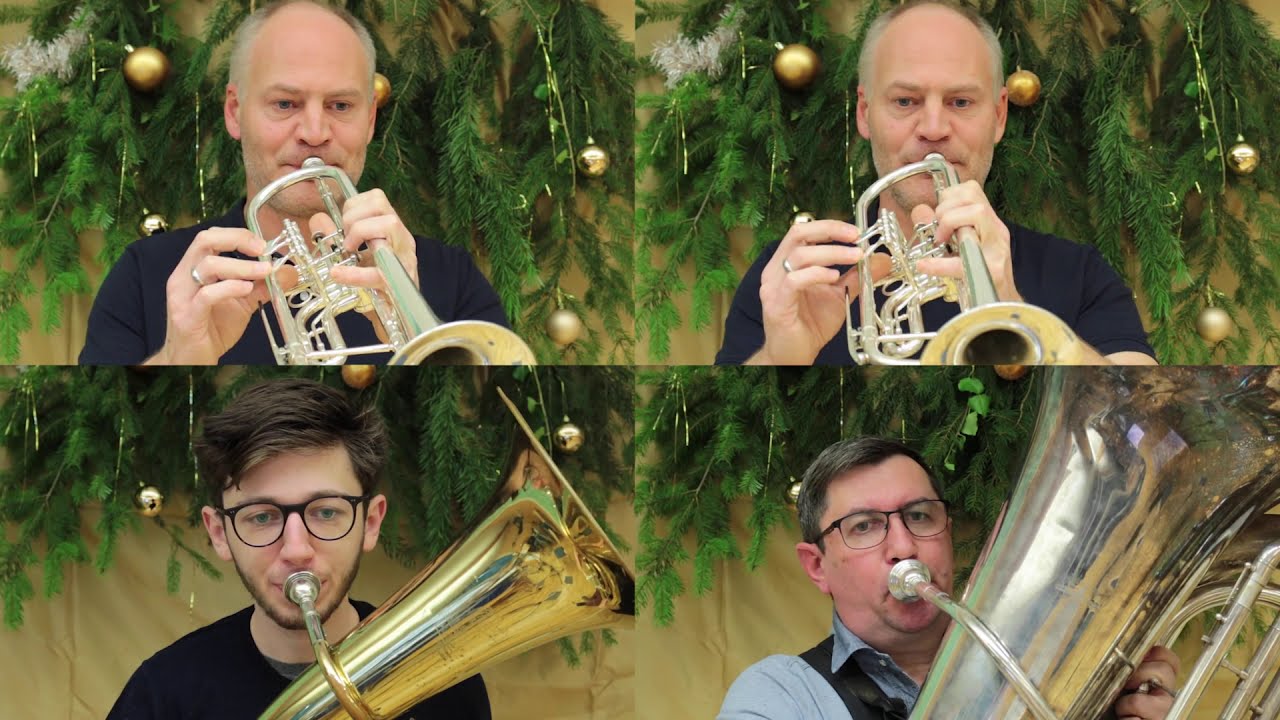
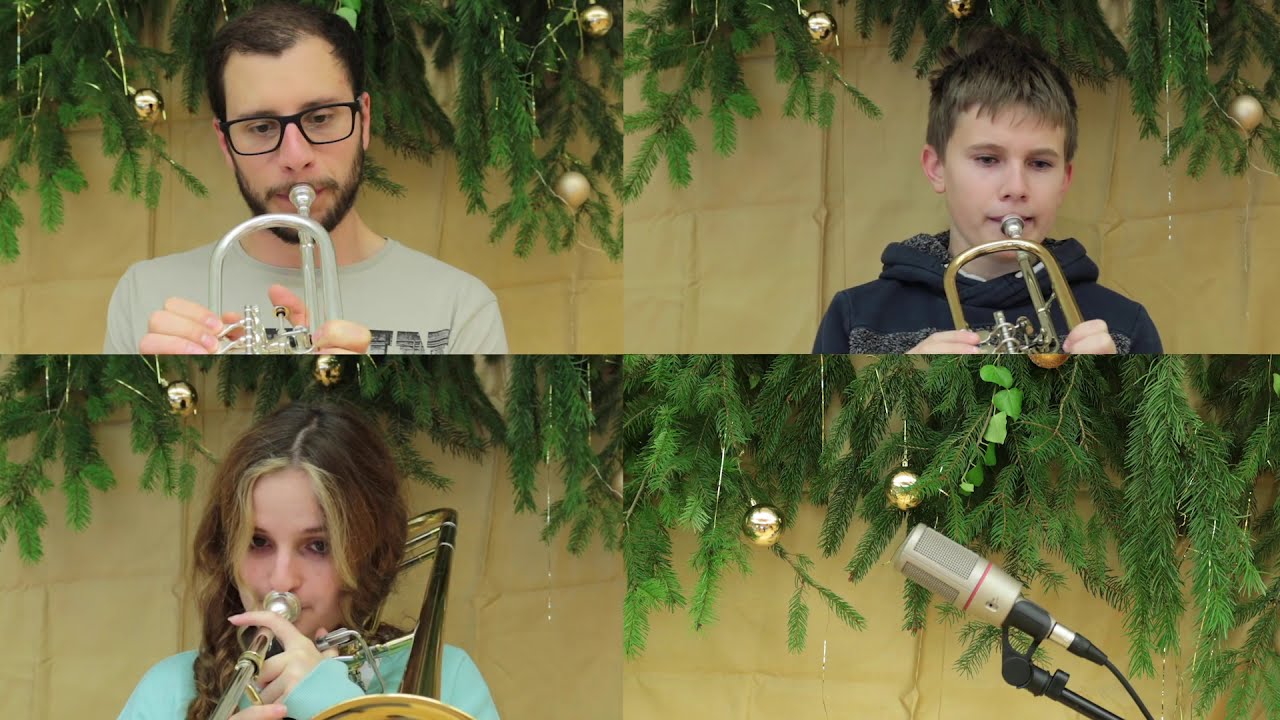
The local brass band “Trachtenkapelle Thalheim” did the same and posted a total of five videos online - one for each Sunday before Christmas starting November 29th and one on Christmas Eve. I supported by doing audio recordings and by providing arrangements.

“O Tannenbaum” was a natural choice for the Sunday right before Christmas Eve, when people would set up their Christmas trees.

The arrangement itself started out as a last-minute thing just two days before Christmas Eve in 2019. This year I upgraded it with a trumpet solo to feature my friend Erwin. I know him for over 20 years and both of us mostly focus on Jazz these days. We regularly meet at Jazz Jam Sessions. Or I should say, we used to regularly meet at Jazz Jam Sessions before Corona hit.

I think he did a nice solo! Here’s the youtube video featuring Erwin:

Video: 4. Adventsonntag: O Tannenbaum

Merry Christmas everyone!

Read more →

Download brass quartet sheet music: Andachtsjodler.

Please note that “Andachtsjodler” is also part of the compilation Christmas Reharmonized, Volume 1 & 2.

Here’s what it sounds like when played on a piano:

The Story Behind

Around 2000 I was one of the most active trombone players within my 30 km radius (my radius as a trombone player is more link 500 meters these days). On the 23rd of December of 2000 I was hired to play with a brass quartet in the “Welser Altstadt” (see Google maps, we played within 10 m of that location). I was a teenager back then and at a point in my life where 100 EURs plus open bar felt like I had conquered the world. I even got to kiss a girl later that night. But that is not the point.

The point is that I heard (because I played it) an Austrian Christmas tune called “Andachtsjodler” for the very first time in my life that night. I had never heard or played it before, but when we played it the innkeeper who had hired us (he was pretty drunk by the time) started to cry. It was not only him, the song also touched me.

More than 10 years later I improvised a piano version of the “Andachtsjodler”:

Listen on SoundCloud

Recently I distilled it into a first brass quartet version, which I later edited for a video project of a local brass band:

Video: 1. Adventsonntag: Andachtsjodler

I hope it helps you beam yourself to Austria and experience some of the magic that still surrounds Christmas.

Creative Commons Licence

This work is licensed under a Creative Commons Attribution 4.0 International License.

Read more →

Still, Still, Still

· Music


Download brass quartet sheet music: Still, Still Still.

Please note that “Still, Still, Still” is also part of the compilation Christmas Reharmonized, Volume 1 & 2.

Here’s what it sounds like when played on a piano:

The Story Behind

I started working on this arrangement on the 24th of December 2019. I did not finish it in time to be played in 2019. So here it is for your convenience for the somewhat unconventional 2020 Christmas Season.

The intention behind this arrangement was that it could serve as the first piece for the upcoming collection “Christmas Reharmonized, Volume 2”. Thus I wanted it to begin sparsely, similar to the Andachtsjodler. “Still, Still, Still” starts with an intro (B*): A sparse version of the song that becomes denser and denser until all instruments are active and the voicings have a certain spread at the end of this first version. The second version (A) is the straightforward version of the song that I usually have in my Christmas carol arrangements. I feel that the song “Still, Still, Still” has a lot of grace, and I tried to honor this by deploying ornaments and delayed harmonic resolutions.

The last version (C) is where I added some harmonic seasoning. The song has an ABA form. I had to redo the first A multiple times to strike the balancing act between “artificial sophistication” and “chords that sound fresh and convey: don’t take this too seriously”. For B I was going for a continuous increase in energy level towards the reprise of A, which I perceive as the climax of the song. Also, I wanted to architecturally mend the transition from B to A so that it can’t be broken apart. It’d like BA to be perceived as one 8-bar phrase. Way too often one can hear musicians playing Christmas Carols as fragmented, four-bar sequences with long breaks for breathing in between. Don’t be that kind of a musician :)

Read more →

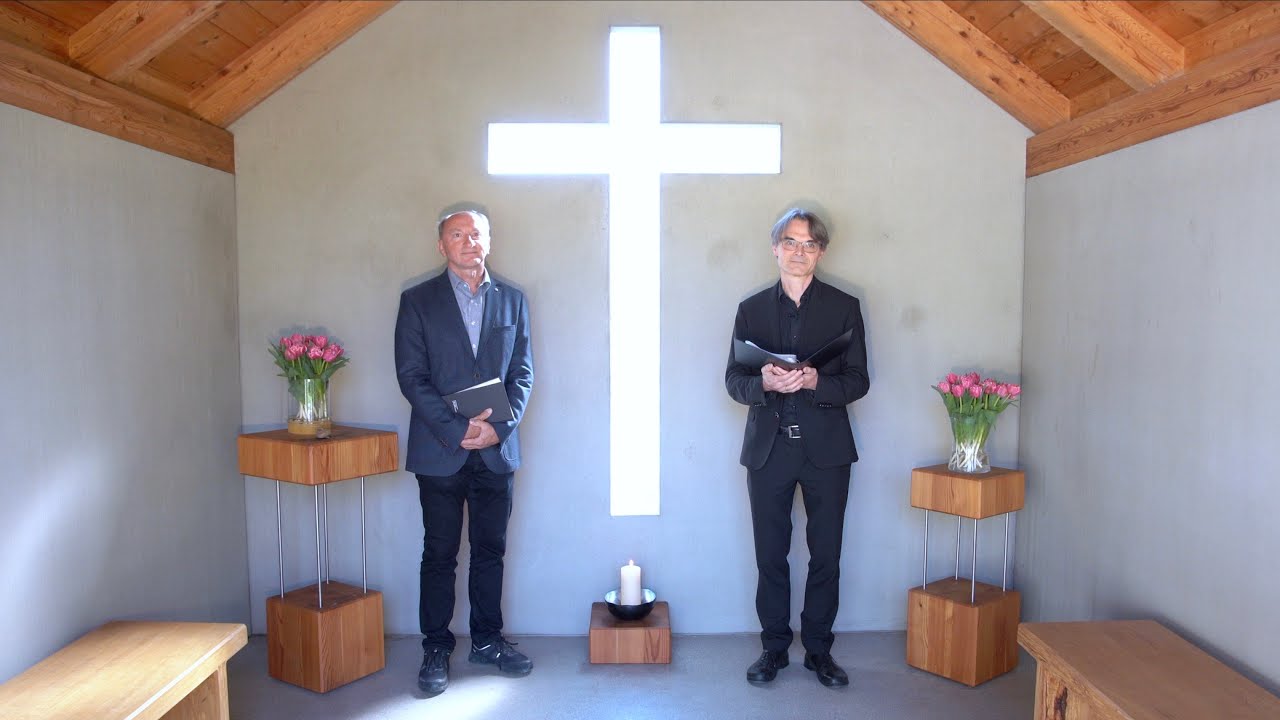
During the COVID-19 pandemic our local church started doing youtube services. A small group of people would prepare texts and music so that it could be streamed by members of the community every Sunday instead of going to church. Every weekend they tried to involve different people or groups to prepare these videos.

I did an arrangement of “What a Wonderful World” for Brass Quintet for one of those youtube videos. Here’s the sheet music for you to download.

With all its sham, drudgery and broken dreams, it is still a beautiful world. Be cheerful. Strive to be happy.

Video: Ökumenische Andacht von der Christuskapelle am Thalbach
Read more →

Coronavirus that bitch. I guess it will hang around a little longer. At least until there is a vaccine available, which should be some time in 2021.

Until then things will stay quite different compared to what we were used to. Different is not necessarily bad, and I think I’ve come to terms with the limitations and the new chances. However, there’s one thing that I really, really miss: Playing concerts and playing at Jazz jam sessions. For me it’s not an economic necessity, but a need for which I simply can’t get a fix right now.

Here’s a video I’ve made for a recent composition of mine. I really look forward to playing the tune live in front of an audience.

Video: Little Grunge
Read more →

The Corona Situation is omnipresent. What are the changes in my daily life? Actually, I should say our daily lifes.

Being at Home Almost 24/7

Both, Andrea and I, are working from home now. This means that we spend almost all of our time within the walls of our apartment. As a couple, I think we are dealing with the situation extremely well. I think that the mutual respect and the self-confidence that both of us have are imperturbable. However, there are a few prerequisites that we agreed on pretty quickly:

  1. We have separate office spaces.
    Fortunately, our apartment is big enough so that we can work in different rooms. We outfitted both rooms with nice desks, external monitors, proper office chairs. We also established the rule that the other party is only allowed to enter after knocking and upon invitation. It’s one essential key to our sovereignty.
  2. We need to be tidier than usual.
    During any random week, when we would leave the apartment for work at around 7 am and come back after 7 pm, we would not care if there are dirty plates around the kitchen. But now that our home is where we spend most of our time, it really matters.

We Cook Every Day

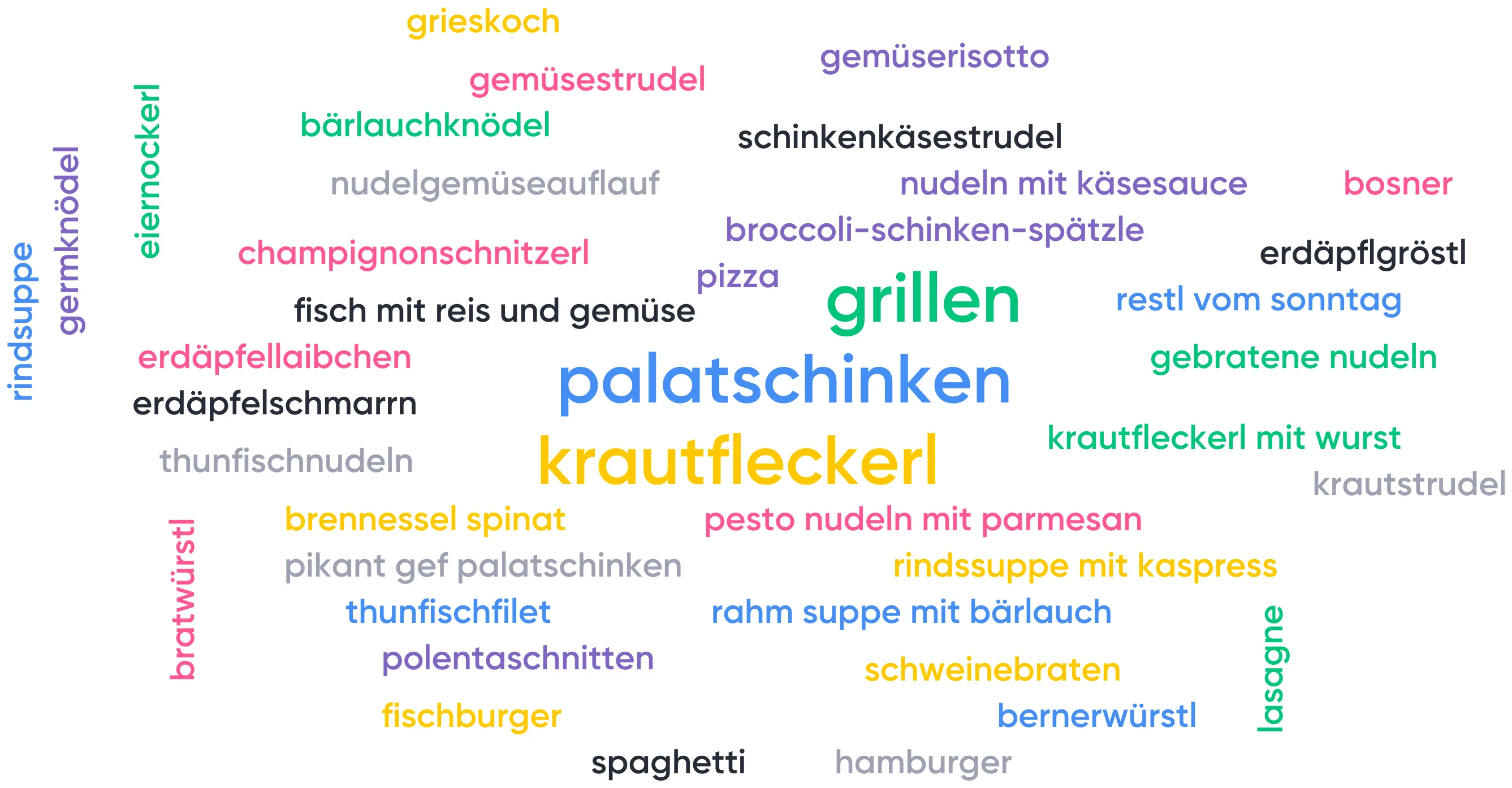
Being at home every day we were faced with two questions: What to eat and how to prepare it? This might sound trivial, but for two adults who had gotten into the habit of eating at restaurants, canteens or simply grabbing sandwiches this meant a big change. We quickly agreed that we would take turns every day preparing lunches. Andrea had a fantastic idea for the “What to eat?” issue. She started an online survey asking “What will you have for lunch this week?”. Thanks to contributions from family and friends we now have this awesome list pinned to our refrigerator:

We Go for Walks Every Other Day

Usually, I would bike to work. Now that we are grounded, we decided to go for walks every other day. If our work schedules allow for it we try to block an hour in the afternoon.

We Go Shopping Only Once a Week

We have a grocery store right in front of our apartment building, which in normal times, is open until 8 pm every day. Usually, we would go there almost every day to grab some small bite for dinner. We used to joke that the store is just an extension of our refrigerator. With us doing some propper cooking now and all the restrictions in place we reverted to shopping once a week. More on that in another post.

This list only addresses adjustments or changes. I believe there are a couple of components in my life that are crucial right now but they were there in the first place. For instance, a daily routine, which is there through well-groomed habits and things such as the daily project stand-up meeting at 8:30 am.

Apart from the things described above my daily life now isn’t that different at all.

Read more →